“Our greatest glory is not in never falling, but rising every time we fall”

Bangalore was once a city full of breathtaking lakes, and was once known as “the city of lakes”. The city’s founders constructed many such man-made lakes as part of a very clever irrigation system. It has no major perennial rivers to satisfy its water requirements and hence, we rely a lot on lakes and bore wells.

Since then, the number of lakes has reduced from 280 in 1960, and the figures have now declined to 81 out of which only 34 are recognized as live lakes.  In highly urban areas, such as Whitefield, the water table has decreased from 300 to 28m.

An unprecedented increase in population and large scale industrialization has led to the water being very contaminated. The city releases over 1600 million liters in untreated sewage into these remaining lakes, along with other industrial effluents. This number will only increase over a period of time as more people move into the city. 


One dirty fish spoils the entire pond

I once thought that lakes are singular water bodies. To my surprise, many lakes are sourced by other water bodies such as streams or rivers, and in cities which rely on lakes such as Bangalore, all the lakes are interconnected by a system of streams. These keep the water in the lakes balanced, an overflowing lake would transfer water downstream into another lake with a greater capacity.

Therefore we can say that in a lake valley, the water quality and content would be similar. If a lake upstream is polluted, a lake downstream would suffer similar consequences. This connectivity did not allow an overflow of water out of the lake into the surrounding area as an additional quantity of water was transferred to other lakes through the channels. Image result for lakes bangalore map

Let me take the example of the Varthur and Bellandur lakes. These lakes are the largest and the most polluted lakes in Bangalore, with very similar water quality. Notice how these lakes lie in the same valley system and are interconnected through various channels.


A confusing Paradox

Every morning for the last 2 years, I have been waking up with a luxury that’s almost absent in most metros in India – clean cold air, the chirping of birds and the greenery all around me.

Honestly, when I moved to Bengaluru, that’s the big thing that got me vs. Mumbai where I lived before. When I leave on my school bus at 7 am, you’d think I’ll only get more of this paradise.

Paradise, did you think?

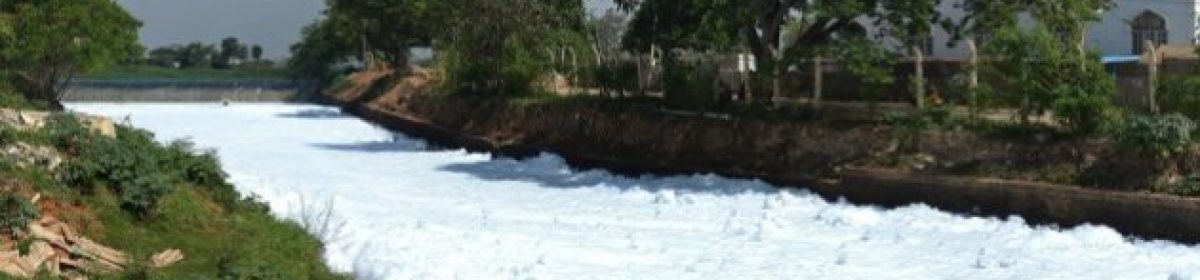
Consider this. My school bus route takes me from Whitefield to Sarjapur Road through the now infamous Varthur lake, the 2nd largest lake in the city. Frankly, when I first saw the foam emerge from the lake, I was shocked. This sounded more like a doomsday movie special effects rather than one of the most natural cities in the country! And on that very exact day, I read an article on the newspaper about a lake which had caught fire.Image result for varthur lake image not copyrighted

As a personal project, I resolved to understand what’s behind it? What is the pollution? How can it be addressed? Who is responsible?

Frankly, a very scary prospect, considering the number of lakes that have disappeared and been polluted to a large extent. What can I do when many eminent people and societies have been trying and grappling with the water pollution in Bangalore and yet the condition is still this pathetic?


Design a site like this with WordPress.com
Get started